S8 E4: Here Kitty Kitty: The Story of Toxoplasma gondii

You can reach me on the website at http://www.causeofdeath100secs.net or you can email me at mailto:Jackie@causeofdeath100secs.net. My Link Tree can be found at: https://linktr.ee/CauseofDeathpod When I was in college, I had a Microbiology professor...

 Apple Podcasts

 Spotify

 Spreaker

 Podchaser

 Castro

 RSS Feed

 Goodpods
You can reach me on the website at http://www.causeofdeath100secs.net or you can email me at mailto:Jackie@causeofdeath100secs.net. My Link Tree can be found at: https://linktr.ee/CauseofDeathpod When I was in college, I had a Microbiology professor who swore that cats were out to kill us all. She told everyone in any class that she taught that cats carried every disease known to man and they were going to pass them all to us. Cats were single-handedly going to end humankind. Now, she knew this wasn’t true and if you’ve listened to any of my past episodes, you know it’s not true, but today, I’m going to talk about a parasite that cats carry that could have a significant impact on cat owners. Toxoplasma gondii Show Notes: https://www.cdc.gov/dpdx/toxoplasmosis/index.html https://www.cdc.gov/parasites/toxoplasmosis/health_professionals/index.html#tx https://www.cdc.gov/parasites/toxoplasmosis/gen_info/faqs.html https://www.vet.cornell.edu/departments-centers-and-institutes/cornell-feline-health-center/health-information/feline-health-topics/toxoplasmosis-cats https://www.ncbi.nlm.nih.gov/books/NBK563286/ https://www.ncbi.nlm.nih.gov/pmc/articles/PMC3162817/ https://emedicine.medscape.com/article/1743814-overview?form=fpf https://journals.asm.org/doi/10.1128/cmr.00115-19 https://www.merckmanuals.com/professional/infectious-diseases/extraintestinal-protozoa/toxoplasmosis https://www.cell.com/trends/parasitology/abstract/0169-4758(88)90018-X https://www.ncbi.nlm.nih.gov/books/NBK7752/ https://www.ncbi.nlm.nih.gov/pmc/articles/PMC3109627/ https://www.sciencedirect.com/topics/medicine-and-dentistry/toxoplasma-gondii https://emedicine.medscape.com/article/229969-overview?form=fpf https://parasitesandvectors.biomedcentral.com/articles/10.1186/s13071-020-04528-x https://www.nature.com/articles/s41467-021-24092-x https://parasitesandvectors.biomedcentral.com/articles/10.1186/s13071-020-04445-z https://www.childrenshospital.org/conditions/congenital-toxoplasmosis https://www.nature.com/articles/s41537-022-00292-2 https://onlinelibrary.wiley.com/doi/epdf/10.1111/j.1550-7408.2008.00345.x https://pubmed.ncbi.nlm.nih.gov/19744303/ https://onlinelibrary.wiley.com/doi/epdf/10.1111/j.1863-2378.2009.01276.x https://emedicine.medscape.com/article/229969-overview?scode=msp&st=fpf&anfErrHint=true&icd=login_error_gg_mismatch_fpf&client=205502&urlCache=aHR0cHM6Ly9lbWVkaWNpbmUubWVkc2NhcGUuY29tL2FydGljbGUvMjI5OTY5LW92ZXJ2aWV3P2Zvcm09ZnBmJnNjb2RlPW1zcCZzdD1mcGYmc29jaWFsU2l0ZT1nb29nbGU&su=EXUHB2/fkQ9sBjQl7hkqDIHTs0Xd4JxI8gikIGYJMIgmCZ+wTe/gcdb9CztGtN/y&form=login https://onlinelibrary.wiley.com/doi/abs/10.1111/j.1863-2378.2009.01276.x https://www.scielo.br/j/mioc/a/c3zTqcQyh8DMhN3NpCddHGs/ https://www.researchgate.net/publication/24416205_Toxoplasma_gondii_1908-2008_homage_to_Nicolle_Manceaux_and_Splendore https://www.semanticscholar.org/paper/Toxoplasma-gondii%3A-1908-2008%2C-homage-to-Nicolle%2C-Ferguson/fe26b8691f59bebf521dd5530b978b23240e68d5 https://www.sciencedirect.com/science/article/abs/pii/S0020751909001064 https://www.academia.edu/61852031/Toxoplasma_gondii_1908_2008_homage_to_Nicolle_Manceaux_and_Splendore https://emedicine.medscape.com/article/229969-overview?form=fpf https://link.springer.com/chapter/10.1007/978-1-4612-2476-1_27 https://pubmed.ncbi.nlm.nih.gov/19430635/ https://pubmed.ncbi.nlm.nih.gov/3535705/ https://link.springer.com/chapter/10.1007/978-1-4612-2476-1_27 https://parasitesandvectors.biomedcentral.com/articles/10.1186/1756-3305-6-334 https://www.sciencedirect.com/science/article/abs/pii/S0020751909000964 https://www.sciencedirect.com/science/article/abs/pii/S0020751909000964#bib76 https://www.sciencedirect.com/science/article/abs/pii/S0020751909000964#bib102 https://www.sciencedirect.com/science/article/abs/pii/S0020751909001064 https://www.sciencedirect.com/science/article/abs/pii/S0020751909000940 https://www.sciencedirect.com/science/article/abs/pii/S0020751909000605...
0:00 The Missing Magnolia's podcast tells the stories of the missing and murdered. Ultimately, these kids went to Saint Hussy and they never came out. Together with Missing Persons expert doctor Michelle Jahni's we uncover the real true crime experience. Every time we do another interview, I'm like, how do we find so many badass women? We hear from victims who turn their pain into something positive. We didn't find out two we're eleven or twelve years old that our mom was murdered in Times Square. It said Mickey Schuenich fought for her life. An experts who think outside the box to sell cases. Nice scour missing Person's database is like namous to see if they're uploaded to that database. Subscribe to Missing Magnolia's on Apple, Spotify, or wherever you get your podcasts today. Well, hello there, I'm Regina King, the Evil Queen, and I'm Lynn Rosskamp, Dosent of Darkness, and we're the hosts of Disturbing Interests. Do you get excited about mummies? Decorate in skulls, obsess over the loss of the Library of Alexandria even though it was lost in a different age. Do you kill the conversation with your in depth serial killer knowledge, facts about items made out of human skin, or have a strange longing to know the softer side of Mothman. Have you spent an objectively disproportionate amount of time studying the life of Ajhlmes? Oh, I wouldn't know anybody like that. No, certainly
1:34 not. Well, I mean we did call our podcast disturbing interest for a reason. That's right. We've got them, and we are doing you the favor of keeping the questions like at what temperature does it take to destroy a cadaver out of your browsing history. Well, we hope, because with us, you might be disturbed, but you're not alone. You can find us on any podcasting platform under Disturbing Interest, or check us out online at disturbing interest dot com. Welcome to Creepy Tapas, the show where two spooky best friends give you tiny tastes of terror connected by a common ingredient. We serve up movie reviews, mysteries, murder, mayhem, and tantalizing tales from the depths of the Internet, and some random bullshit too, all focused around a similar theme. We blend our love of horror, oddities and general creepiness and dig a little deeper, discovering the history, psychology, and truth behind your wildest fears. Join us Ash and Jordan as we descend into full darkness.
2:40 Every Sunday, wherever you listen to podcasts, it's creepy tapas, y'all? What what crowd? Members of the dark Cast Network. Darkcast Network, come on over to the dark Side. We're really nice people once you get past the true crime and scary science. Hello, and welcome to Cause of Death one hundred seconds to midnight. I'm your host, Jackie Morante. When I was in college, I had a microbiology professor who swore that cats were out to kill us all. She told everyone in any class that she taught that cats carried every disease known demand and they were going to pass them all to us. Cats were single handedly going to end humankind. Now she knew this wasn't true, and if you listen to any of my past episodes, you know it's not true. But today I'm going to talk about a parasite that cats carry that could have significant impact on cat owners. We're going to explore Toxoplasma GANDHII. Let's begin with ediola and pathology. Toxoplasma gandhii is an obligate parasitic protozoin that causes toxoplasmosis. The classification of Toxoplasma Gandhii is as follows.
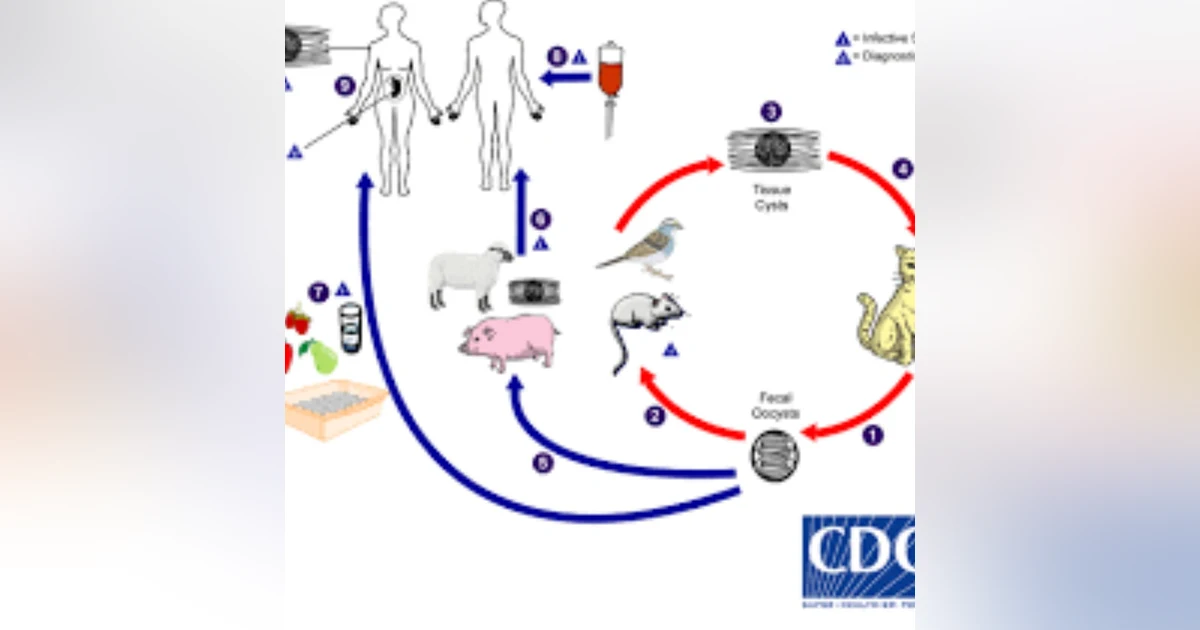
4:15 It's in the class Canoida Cida, the genus Toxoplasma, the domain Eukaryota, the family sarco cystiday, the order Eucoxidiorida, and the phylum Apicomplexa. Most parasites will have a host animal. This host is necessary to complete the life cycle. For Toxoplasma gandhii. That host is felines. Unsporeulated ucytes are shed in the cat's feces. The cats only shed the oucytes for between one and three weeks, but large numbers of them may be shed. The ucytes take between one and five days to spoulate in the environment. Then intermediate hosts become infected after ingesting infected soil, water, or plant material. Shortly after ingestion, the usis transform into tachyozytes, which localize in neural and muscle tissue.
5:20 These develop into cyst bradiozoids. Cats become infected when they eat the intermediate hosts, including birds and mice. They could also become infected after coming into contact with spoilated usis in the environment. Livestock and wild game can also become infected after ingesting spoiulated usis in the environment. In the human host, the parasites form tissue cysts in skeletal muscle, myocardium, brain, and eyes. These cysts may remain throughout the life of the host. People get infected with Toxoplasma gondii through several routes. The most common are eating undercooked meat of animals that harbor the parasite, consumption of food or water contaminated with cat feces. This includes changing the litter boxes from your favorite motor boat or through blood transfusion or organ transplantation, and transfer from mother to fetus in the womb. Testing includes biopsy of tissue cysts, zerology, and in the cases of transplant scental transfer DNA detection by PCR through amnionic fluid. Clinical presentation varies. Immunicompetent people will present as a symptomatic since the immune system suppresses the infection. However, ten
6:53 to twenty percent of patients with acute infection may develop cervical lymphidemopathy. With or without flu like symptoms. My loyal listeners know that just about everything in one way or another presents as flu like symptoms. In immunocompetent people, the clinical course is usually not serious and is self limited, and symptoms will resolve within a few weeks to a few months. In rare cases, ocular infection with vision loss can occur. Immunodeficient patients often have central nervous system disease, but may also present with retinol choreoiditis ornuminitis. AIDS patients will experience toxoplasmic encephalitis, leading to intra cerebral mass lesions. It's thought that these lesions are caused by a reactivation of chronic infection. Congenital toxoplasmosis is caused by an acute primary infection in the mother during pregnancy. The incidence and severity of congenital toxoplasmosis ferries by the trimester in which the disease was acquired by the mother. Diagnosis of the mother is extremely important because treatment may reduce the incidence of infection and reduce the
8:24 squalae in the infant. Ocular toxoplasma infection can be the result of congenital infection or infection after birth. In congenital infection, patients often remain asymptomatic until they're in their twenties or thirties, before lesions develop in the eye. Toxoplasmosis is one of the most common human infections in the world. There are places where incident rates are higher. In France, higher rates of disease are related to a preference for eating raw or undercooked meats, while in Central America higher rates are blamed on the abundance of stray cats in an area where usis are likely to survive. Treatments target the tachyozod stage of the parasite, but these drugs don't eradicate the insistent parasites in the tissue. Perimethamine is the gold standard drug for treatment of toxoplasmosis. Since it can also suppress the bone marrow of the patient, it's often given with folinic acid. Pholinic acid protects the bone marrow from the toxic effects of parimethamine. Sulfurdiazine or clindamyasin are often given concurrently.
9:46 In severe cases. Treatment may last two to four weeks. Toxoplasmosis in immunodeficient patients is often fatal if not treated. Treatment may last from four to six weeks after resolution of all clinical signs, and may be required for six months or longer, depending on the severity of the disease. Relapses are known to occur in AIDS patients, and maintenance therapy is often suggested until immunologic improvement can be achieved in response to antiviral therapy. Let's take a moment to hear from my sponsors, then I'll be back to talk about some history. Charles Nicole and Lewis Manceau identified the parasite in a North African rodent, the Gundi in nineteen oh eight. At the same time, Alfonso Splendore found the same parasite in a Brazilian rabbit. Their research was presented just days apart, and these three researchers depicted the parasite in very similar ways. They described it as a parasite found both in side and outside of nucleated cells, but never in red blood cells. It had a round or puriform shape and was about five to eight micrometers in length. Splendore went on to describe the effect it had on
11:16 rabbits. The hypertrophied and discolored spleens, the enlarged liver and lymph noodes, and the ulcerated small intestine. He wrote that the cysts were eight to forty micrometers in diameter. Nicole and Manceaux described the morphology of the parasite and the types of tissues that were affected in Gundhis. Both papers compare Tea Gandii to Leishmania. It was so close that Nicole and Manso first proposed calling the parasite Leishmania gondii. They proposed the name Toxoplasma Gandii in nineteen oh nine, based on the shape of the infectious stage of the parasite. In Latin, toxin means arc or bow, and plasma means life. It's rumored that Gandie came from a misspelling of the animal that the researchers founded in the Gundi. Castellani first described a T. Goondii like parasite in blood and spleen smears from a fourteen year old boy from Ceylon who died from a disease that presented with severe anemia, fever, and splenomegaly. In nineteen sixteen, Federovich observed similar organisms in the blood of a ten year old boy from the Black Sea region who presented with the same symptoms seen in the boy from Ceylon. In nineteen twenty,
12:54 again, a similar organism was reported by Chalmers and kamar in a soul who presented with symptoms that included chronic headaches, fever, and diarrhea. These cases were not studied in depth, and it's possible that they could be due to leaichmania. The first clear case of toxoplasmosis wasn't recognized until nineteen twenty three, when a carriage driver brought his eleven month old son to the children's clinic of Professor Pesina. The child was suffering from increasing hydrocephalus. The child died, and both the clinical description and autopsy results showed that the child had congenital toxoplasmosis. The autopsy read in part quote in the papila, the center of the area just described there was a rich black pigment which was combined with a grayish white, shiny material of azure tone and finally stranded running horizontally to the nasal edge of the abnormal spot in the macular region. Retinal veins were missing in the area of the lesion end quote. Several sporosis were identified in the child's body. In this case, photo micrographs were taken of the samples from the autopsy, but were later destroyed in the bombings during World War II, so confirmation of the findings is no longer possible. In nineteen twenty seven,
14:30 Torres described a similar case in an infant from Brazil who died of convulsions two days after birth. Djenku had only referred to the organisms he found as sporozoa, and Torres as encephalitizun Chegazi neither Taurus nor Jangku definitively named the pathogen as tigondii, but in a nineteen twenty eight review of the cases, Leveeddi suggested that both deaths were due to Toxoplasma gandhii. In nineteen twenty nine, Kulan observed parasites in the spinal fluid of a seventeen year old boy from Corsica who died of meningitis. Kulan referred to the parasite as e brumpti. Wolf and Cohen described a parasite in the nervous system and retina of an infant with encephalitis corrioritonitis, an internal hydrocephalus in nineteen thirty seven, they called it ehominus.
15:35 Staban would look at the samples that Wolf and Cohen took and would say that the parasite that they found was indistinguishable from TIGANDII. He would note that the confusion lay in the difference in appearance between humans and samples taken from laboratory animals that had been infected with Ti GANDII. True research in tigandi I didn't begin until nineteen thirty nine, when Wolf, Cohen, and Page identified it as a cause of human disease. The research began when a child was born at Baby's Hospital on May twenty eighth, nineteen thirty eight. The little girl was full term and delivered by c section. After three days, the child began to have seizures and choreoretinitis was present in both eyes. The baby died shortly after birth, and when an autopsy was performed, free and intracellular lesions of encephalomyelitis and retinitis were found. These are hallmarks of TIGONDII. Sections of the child's cerebral cortex and spinal cord were homogenized in saline and inoculated interest cerebrally into rabbits and mice. Tegondii was isolated from these animals. Upon netcropsy, Tea Gandhii from these animals was inoculated into other mice, and they in turn developed
17:06 the disease. What this proved was that the human strain was no different from the isolates taken from other animals. The first reports of Tea. Gandhii infection without neurological symptoms came in nineteen forty and nineteen forty one. In nineteen forty, Pinkerton and Wineman reported finding Tea. Gandhii in the tissues of a twenty two year old man from Peru who died of Bartonella infection and fever. In nineteen forty one, Pinkerton and Henderson reported on two adults aged forty and fifty from Saint Louis, Missouri, who died of atypical pneumonia and a spotted fever like syndrome. In nineteen forty two, Sabin proposed that there were four clinical signs that could be attributed to congenital talk so plasmosis. These were hydrocephalus or microcephalus, intra cerebral calcification and choreo retinitis. In nineteen fifty one, this proposal was shot down when Frankel and Friedlander published a detailed account of five fatal cases of hydrocephalitis in infants. Tigondii was only isolated from two of the patients.
18:30 It came to the forefront that rubella, cmv, HSV and syphilis could cause the same symptoms that Sabin proposed in nineteen forty two. Often, tuberculosis was also a culprit in infant deaths where hydrocephalus was present. The first test, the dye test, was developed in nineteen forty eight by Sabin and Feldman. This test is still a gold standard for diagnosis today. It's both sensitive and specific, with no false results in humans. This test accomplished two things.
19:11 It allowed epidemiologists to study the scope of the infection and determine the prevalence of the pathogen worldwide. It also demonstrated that the symptoms of congenital clinical toxoplasmosis occurred in other diseases, but this test could differentiate between Tigondi and other diseases that presented with the same symptoms. Before nineteen fifty almost all cases of ocular toxoplasmosis were considered to be caused by congenital transmission. In nineteen fifty one, Rieger found that post natal transmission of the disease was possible. He also surmised that recurrence was possible in immune compromise people of all ages. The link between T. Goondii and choreoretinitis was found in nineteen fifty two by Helen R.
20:08 Campbell Wilder Forester, a technician of the Registry of Ophthalmolic Pathology at the Armed Forces Institute of Pathology in Washington, d c. She studied fifty three eyes taken from patients with ocular disease. It was proposed that the ocular disease was associated with tuberculosis, but as Wilder began to perform tests on the eyes, she found no evidence of bacteria or spirakeets by special staining. She went on to perform the dye test on the retinas of the eyes and found Tegondii as the source of choreoretinitis. All the eyes presented with lesions that were granulomitus and had central necrosis. Te Goondie was consistently found in the nec prodic areas.
21:02 Treatment of ocular toxoplasmosis with antimicrobial drugs began in the nineteen fifties. Isles and Coleman demonstrated the use of pyrimethamine and sulfonamines in nineteen fifty three. These drugs remain the gold standard for treatment of ocular toxoplasmosis today. Garn and Isles found that spermiasin was effective in treating mice with toxoplasmosis in nineteen fifty eight. Spermiasin is non toxic and does not cross the placenta. This makes it a wonderful prophylactic treatment for pregnant women who are infected with Tigondii to ensure that they don't transmit the parasite to their unborn children. George Desmonts began looking at serro conversion in pregnant women in the nineteen sixties. These studies were performed in Paris, France, and last did fifteen years. This study yielded some of the most important findings on Tigondii infection during pregnancy. First, the study found that infection acquired during the first two trimesters of pregnancy was the most damaging to the fetus.
22:18 Secondly, transmission was dependent on when the women acquired the infection during the pregnancy. Thirdly, women who were seropositive before they became pregnant did not transmit the infection to the fetus, and finally, treatment with spermiasin reduced the chances of congenital transmission. A similar experiment was done in Austria in nineteen seventy three and the results were very similar to Desmond's findings. A screening program was developed in Massachusetts during the eighties that encouraged neonatal serological screening and early treatment for ti GANDII infection. While there is no bulletproof treatment for congenital infection even now, research is still ongoing. T GANDII infection resulting in encephalitis in immunal compromised patients was first reported in patients with Hodgkin's disease during treatment in the late nineteen sixties.
23:26 However, this was rarely seen until the nineteen eighties when the AIDS pandemic occurred. Left In Remington reported a series of patients with encephalitis during that period. It was found that the infection occurred as a result of reactivation of chronic infection related to the defect in T cell immunity caused by infection with HIV. Before antiretroviral therapies were developed, t gandii infection was one of the most common neurological complications patients with AIDS had to face. Today, this infection is rarely seen in patients with HIV thanks to anti viral treatments. Currently, in the US, it is estimated that eleven percent of the population six years and older have been infected with Tea goondii. In some places around the world, more than sixty percent of the population is infected. The rate of infection is highest in lower altitudes, where the weather tends to be hot and humid. There is no human to human transmission of toxoplasmosis other than congenital transmission. Pregnant women who are infected with Tea gondii during or just before pregnancy are at risk of congenital transmission. The women may not be symptomatic, but the consequences are dire for the child. This is why obstetricians will tell expectant mothers to have someone
25:00 else clean the litter box if they own a cat. Brady Zoites can be transmitted through food, so always could meet to the proper temperature, and clean utensils and cutting boards thoroughly before cutting any foods that will be eaten raw. To avoid cross contamination, avoid unpasteurized goat milk. Tachyozites take up residents in goats and they can be passed along in the milk. Actually, just avoid unpasteurized milk altogether. Trust me, you're not losing anything with pasteurization, except a lot of diseases you don't want. Cats play a huge role in the transmission of toxoplasmosis. They can shed millions of usis in their feces. People are often infected by accidental ingestion of cat feces by cleaning litter boxes. The takeaway of that statement is if you have a cat, wash your hands after you clean the litter box. Soap and hot water go a long way to preventing disease. There is also the possibility of accidental ingestion from eating unwashed fruits and vegetables, or accidentally ingesting infected soil from the environment. You know how I tell you to wash bananas. No, I'm not crazy. Just wash everything lastly. On rare occasions, blood transfusions and organ transplants can be the
26:37 cause of transmission. This doesn't mean you should turn down treatment, but there is a very small risk associated with these treatments. Okay, so that's toxoplasmosis. If you'd like to send a nasty ground because I ruined your love of your favorite furry feeling, you can reach me at Jackie at cause of Death one hundred sex dot net. You can also head to the website and leave a message for me at www. Cause of death one hundred sex dot net. While you're there, take a look around read the blog, check out the show notes, and find out what's happening with the show. Speaking of show notes, they're really worth the read. They contain all the research that I did for this episode, and they also give vital information about my sponsors, my social media accounts, and of course, my Patreon page. Don't forget to head to Patreon if you want to support the show. There you'll find several tiers that you can sign up for, and they all have different pers Finally, share these episodes with everyone you know. Go leave a rating and review on your favorite podcatcher. Let your geek flag fly. My podversary is coming up and I have a really special episode brewing. I know you'll
28:07 all enjoy it. Until then, don't forget that dogs rule and cats carry every disease known to mankind, at least according to my microbiology professor, Step School School Stock spoke steps, step st st st st st st stand still, Stan

