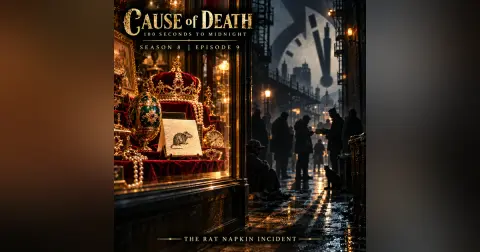
S8 E9: 100 Seconds to Midnight: The Rat Napkin Incident

 Apple Podcasts

 Spotify

 Spreaker

 Podchaser

 Castro

 RSS Feed

 Goodpods
The Shadow Economy Show Notes
The Rat Napkin Incident — Halloween Show Notes
Captain Obvious needs gas money. An influencer buys his three-dollar rat napkin. Before long, there are numbered editions, resale listings, forged certificates and collectors borrowing money to buy rats. Somewhere in Roswell, Steve is opening a closet full of luxury bathrobes.
This Halloween, we follow the napkins through scarcity, speculation, counterfeiting and a market collapse. Behind the absurdity are questions about where value comes from, who profits when prices climb, and what happens when buyers can no longer trust what they’re getting.
The napkin buyer can walk away. Someone looking for food, fuel or medicine may not have that luxury.
The Rat Napkin Incident is an original fictional story developed by Jackie Moranty and Quinn, her ChatGPT AI assistant, from the shared lore of the Cause of Death Art Garage. The final script was reviewed and corrected by Jackie Moranty.
Captain Obvious, Steve’s collectible-merch closet, the numbered napkins, their prices and the transactions described are invented. They are not accounts of an actual Goodwill operation, influencer scandal or collectible market. The Roswell Goodwill storyline is fictional.
The economic concepts and factual claims draw on the sources below. The fictional scenes illustrate those mechanisms; they are not research findings. Written and hosted by Jackie Moranty, with AI-assisted drafting and research.
A shadow economy includes activity hidden from public authorities: unreported income from otherwise legal goods and services, as well as illegal trade under the broad definition used here. Some economic studies define it more narrowly. Ordinary collecting, speculation and legitimate resale are not automatically illegal or hidden economic activity.
IMF — Hiding in the Shadows: The Growth of the Underground Economy (2002)
Supports the broad shadow-economy definition, including concealed income from lawful activity and illegal trade.
https://www.imf.org/external/pubs/ft/issues/issues30/index.htm
OECD/EUIPO — Mapping Global Trade in Fakes 2025
Estimates international counterfeit trade at approximately $467 billion in 2021, equivalent to 2.3% of global imports. The report was published in 2025; the estimate uses 2021 data and is not a total for the entire shadow economy. It also examines affected products and enforcement challenges.
https://www.oecd.org/en/publications/mapping-global-trade-in-fakes-2025_94d3b29f-en.html
FTC — Bringing Dark Patterns to Light (2022)
Documents misleading countdown timers, false limited-time offers and other tactics that impair consumer choice. A genuinely limited edition is different from falsely claiming scarcity or a deadline.
https://www.ftc.gov/reports/bringing-dark-patterns-light
USPTO — About Trademark Infringement
Explains unauthorized trademark use that is likely to confuse people about the source of goods. Counterfeit branding differs from a product merely having a similar style.
https://www.uspto.gov/page/about-trademark-infringement
US Code — 18 USC §2320: Trafficking in Counterfeit Goods or Services
Federal criminal law addresses intentional trafficking involving knowing use of counterfeit marks. The episode’s fake branded purses and sunglasses illustrate counterfeit trade; its forged napkins also illustrate fraudulent sales.
https://uscode.house.gov/view.xhtml?edition=2023&num=0&req=granuleid%3AUSC-2023-title18-section2320
OECD — Countering Illicit Trade in Online Marketplaces
Research and policy resources on counterfeit distribution through digital marketplaces. Illegal trade can take place through ordinary-looking online storefronts.
https://www.oecd.org/en/topics/sub-issues/countering-illicit-trade-in-online-marketplaces.html
UK National Archives — Illegally Selling Coupons
A wartime record documenting illegal ration-coupon trading, with historical context on rationing and black markets.
https://www.nationalarchives.gov.uk/education/resources/home-front-1939-1945-part-two/illegally-selling-coupons/
Federal Reserve — Financial Stability Report, November 2025: Purpose and Framework
Explains valuation pressures, household and business borrowing, financial-sector leverage and funding risks. These vulnerabilities can amplify losses, forced sales and disruptions to credit. The Rat Napkin bubble illustrates the mechanisms; it is not evidence of a real financial crisis.
https://www.federalreserve.gov/publications/november-2025-financial-stability-report-purpose-and-framework.htm
Cause of Death – 100 Seconds to Midnight explores threats to civilization and the science, history and human decisions that shape them.
Website: https://www.causeofdeath100secs.net
Email: jackie@causeofdeath100secs.net
Linktree: https://linktr.ee/CauseofDeathpod
Instagram: @CauseofDeathpod
Threads: @causeofdeathpodcast
Facebook: @COD100Secs
Twitter/X: @CauseofDeath10
TikTok: @causeofdeath100secs
Listen on all major podcast platforms.
Patreon: https://www.patreon.com/JackieMoranty
Ko-Fi: https://www.ko-fi.com/causeofdeathluckycharmsunplugg
Merch: https://www.teepublic.com/user/causeofdeathluckycharmsunplugged
Every contribution, subscription, review and share helps the show reach more people.
“Time Off” by Damma Beatz
Proud member of the Darkcast Network.
Darkcast on Twitter/X: @darkcastnetwork
Darkcast on Facebook: @DarkcastNetwork
Jackie is also a member of the Southern Gothic Network.
If you liked this episode, pass it around like a souvenir Rat Napkin bottle of liquor. Happy Halloween—and under no circumstances put the apocalypse on a tea towel.
#CauseofDeath100secs #TheRatNapkinIncident #ShadowEconomy #CounterfeitGoods #Speculation #EconomicBubbles #HalloweenPodcast #DarkcastNetwork
Learn more about your ad choices. Visit megaphone.fm/adchoices

