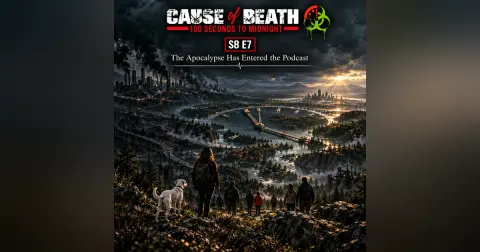
S8 E7: 100 Seconds to Midnight: The Apocalypse Has Entered the Podcast

 Apple Podcasts
 Spotify
 Spreaker
 Podchaser
 Castro
 RSS Feed
 Goodpods
 Cause of Death – 100 Seconds to Midnight
Episode: S8 E7: 100 Seconds to Midnight: The Apocalypse Has Entered the Podcast
The Doomsday Clock has never been closer to midnight.
On January 27, 2026, the Bulletin of the Atomic Scientists moved the Clock from 89 seconds to midnight to 85 seconds—the closest it has ever been to catastrophe.
But the Clock isn’t predicting the end of the world. It’s a warning.
This year, that warning comes from several directions at once: nuclear weapons, climate change, biological threats, artificial intelligence and other disruptive technologies, and the erosion of international cooperation.
The frightening part isn’t simply that these risks exist. It’s that they increasingly interact with one another.
The Doomsday Clock: What Does It Actually Mean?
The Doomsday Clock grew out of the Manhattan Project. In 1945, scientists who had helped develop the atomic bomb formed the organization that became the Bulletin of the Atomic Scientists. In 1947, artist Martyl Langsdorf designed its famous magazine cover: a clock set at seven minutes to midnight.
Originally focused on nuclear danger, the Clock later expanded to include climate change, biological threats and disruptive technologies. In 2026, the Bulletin also emphasized a risk underlying all of them: weakening international cooperation.
The Clock isn’t telling us catastrophe is inevitable. It’s telling us we are running out of margin for error.
Risk #1: Nuclear Weapons
Nuclear weapons are the original reason the Clock exists, and they remain an immediate catastrophic risk.
The Bulletin pointed to continuing conflicts and nuclear brinkmanship, deteriorating arms-control relationships and modernization of nuclear arsenals. The concern isn’t simply how many weapons exist; communication and systems designed to prevent escalation have weakened.
The Bulletin calls for renewed dialogue, restraint and international cooperation to reduce nuclear risk.
Risk #2: Climate Change
Climate change is already changing systems on which civilization depends. Global temperatures remain extraordinarily high, atmospheric carbon dioxide continues to reach record levels, and a warming atmosphere and ocean contribute to both flooding and drought.
The effects can cascade through water supplies, food security, migration and infrastructure. Then there is another growing pressure: data centers.
The Data Center Connection
AI and other computational technologies require enormous computing power, electricity and cooling.
Lawrence Berkeley National Laboratory’s 2025 United States Data Center Energy Usage Report, published in June 2026, estimates data centers could account for 11.8% of U.S. electricity consumption by 2030, with modeled scenarios ranging from 9.5% to 15.3%.
Cooling can require water, while electricity generation can have an indirect water footprint. That matters especially where water is already scarce.
Water Scarcity: The Bigger Picture
The Middle East and North Africa show how climate, technology and water scarcity can collide. The World Bank identifies MENA as a hotspot of unsustainable water use. Meanwhile, Gulf countries are investing heavily in AI and data-center infrastructure while confronting severe water constraints.
The Rio Grande offers another example. It is already stressed by drought, reduced snowpack, heat, reservoir conditions, agriculture and groundwater pressures, while data-center development adds new attention to industrial water use in New Mexico.
Important distinction: data centers did not cause the Rio Grande’s water crisis. The question is how we responsibly add new water and energy demands where those resources are already stressed.
Risk #3: Biological Threats
The Bulletin identified several biological concerns.
Mirror Life: Scientists have raised concerns about synthetic organisms built from molecular structures that are mirror images of those found in nature. A self-replicating mirror organism could potentially evade biological systems and defenses; the Bulletin characterized this as a potentially existential risk.
AI-Designed Biological Threats: AI can help design proteins and biological systems, offering enormous benefits but also potential for misuse.
Biological Weapons: International controls depend heavily on cooperation and shared norms, safeguards the Bulletin warned have weakened.
Public Health Preparedness: Natural disease can also become catastrophic when surveillance, preparedness, expertise and public trust are inadequate.
Risk #4: Artificial Intelligence & Disruptive Technologies
AI can amplify other risks. It can accelerate biological research, influence military decision-making, contribute to misinformation and be incorporated into systems where mistakes could have extraordinary consequences.
The Bulletin has specifically raised concerns about AI in military systems, including nuclear command and control. It also warns about degradation of the information environment: collective action becomes harder when people cannot agree on basic facts.
The Risk Beneath the Risks
Perhaps the most important part of the 2026 announcement isn’t any individual threat. It’s the loss of cooperation.
Nuclear weapons, climate change, biological threats and AI don’t respect national borders. A virus doesn’t stop at a border. Carbon dioxide doesn’t stop at a border. A nuclear exchange doesn’t stay neatly contained. AI-generated information can cross the world in seconds.
The question is whether humanity can cooperate well enough to manage problems no country can control alone.
So… Are We Doomed?
No.
Midnight is not destiny. The Bulletin identifies actions that could reduce these risks, including renewing nuclear arms-control negotiations; strengthening biotechnology safeguards; establishing safeguards against AI-assisted biological threats; reducing fossil-fuel consumption and investing in climate resilience; developing international rules for military AI; protecting nuclear command-and-control systems from unsafe AI integration; rebuilding public-health preparedness and biological surveillance; improving data-center efficiency and sustainability; managing water resources more effectively; and restoring international cooperation and diplomatic communication.
The Clock is a warning—not a prediction. Warnings are useful precisely because there is still time to respond.
The Bigger Question
The question isn’t:
“How close are we to midnight?”
The better question is:
“What are we going to do with the time we have left?”
The history of the Clock is, in many ways, a history of technological capability moving faster than our ability to govern it.
We invented the atomic bomb before we figured out how to live with it.
We’re developing artificial intelligence faster than we understand all of its consequences.
We’re altering the climate faster than we’re adapting our infrastructure.
We’re gaining unprecedented biological capabilities while struggling to maintain the institutions that protect us from biological threats.
The technology isn’t necessarily the problem.
The problem is whether our ability to manage the technology can keep pace with our ability to create it.
And that’s why the Clock is sitting at 85 seconds.
Not because midnight is inevitable.
Because the margin for error is getting smaller.
Sources & Further Reading
The Doomsday Clock
Bulletin of the Atomic Scientists — 2026 Doomsday Clock Statement
Bulletin of the Atomic Scientists — Nuclear Risk
Bulletin of the Atomic Scientists — Climate Change
Bulletin of the Atomic Scientists — Biological Threats
Bulletin of the Atomic Scientists — Disruptive Technologies
Bulletin of the Atomic Scientists — Doomsday Clock Timeline
Bulletin of the Atomic Scientists — Doomsday Clock FAQ
Climate, Water & Data Centers
Lawrence Berkeley National Laboratory — United States Data Center Energy Usage Report: 2025 Update
World Bank — Beyond Scarcity: Water Security in the Middle East and North Africa
World Bank — Finding Institutional Solutions to Water Scarcity in MENA
World Bank — Electricity and Water Access in MENA
UAE Government — Water
UAE Government — Water Security Strategy 2036
UAE Energy & Water Atlas — Water Security
Middle East Council on Global Affairs — AI, Data Centers, Water & Energy in the Gulf
The Rio Grande
Meta — Restoring Water in Our Data Center Communities
Meta — 2024 Volumetric Water Benefits Report
Fact Check — Meta’s New Mexico Data Center and the Rio Grande
About Cause of Death – 100 Seconds to Midnight
Cause of Death – 100 Seconds to Midnight explores threats that could bring civilization to the brink—and the people, science and solutions that might keep us from getting there.
Please rate, review and share the podcast.
Stay Connected
Website — www.causeofdeath100secs.net
Email — Jackie@causeofdeath100secs.net
Linktree — Cause of Death
Instagram — @CauseofDeathpod
Threads — @causeofdeathpodcast
Facebook — @COD100Secs
Twitter/X — @CauseofDeath10
TikTok — @causeofdeath100secs
Support the Podcast
Apple Podcasts — Subscribe through Apple Subscriptions
Patreon — Support Cause of Death
Ko-Fi — Support Cause of Death
Merch — Cause of Death Merchandise on TeePublic
Music
“Time Off” by Damma Beatz
Networks
Cause of Death – 100 Seconds to Midnight is a proud member of the Darkcast Network.
Twitter/X — @darkcastnetwork
Facebook — @DarkcastNetwork
Jackie is also a member of the Southern Gothic Network.
And One More Thing…
Please share the show with someone who needs to hear it.
The goal isn’t simply to stare at the Clock. It’s to figure out how to move the hands back.
Hashtags
#CauseofDeath100secs #85Seconds #DoomsdayClock #BoardofAtomicScientists #GlobalSolutions
Learn more about your ad choices. Visit megaphone.fm/adchoices

