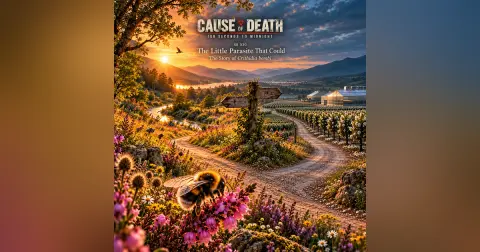
S8 E10: The Little Parasite That Could: The Story of Crithidia bombi

 Apple Podcasts

 Spotify

 Spreaker

 Podchaser

 Castro

 RSS Feed

 Goodpods
S8 E10: The Little Parasite That Could: The Story of Crithidia bombi
Crithidia bombi is a microscopic gut parasite of bumblebees. Its effects depend on the host and its circumstances. Infection can reduce a queen’s success in founding a colony and affect colony performance without immediately killing every infected bee.
The bee’s gut is defended by its immune responses and microbial community. The ileum is an attachment site for the parasite, not an undefended gap in the immune system. Honeybee experiments have found viable parasite cells passing through without demonstrating a successfully multiplying infection. Carrying a parasite and developing an infection are different things.
Heather nectar contains callunene. Experiments showed that exposure can cause incoming Crithidia cells to lose the flagellum they use to attach in the ileum. The crop, where bees store nectar, provides an opportunity for that exposure before the parasite establishes itself farther down the gut.
The 2019 study demonstrated protection against new infection rather than treatment of established infection. A later colony experiment found lower infection prevalence in colonies supplied with heather extract or callunene. Locally appropriate flowering plants and food across the season matter to bee health.
Research around southern Ontario greenhouses found patterns consistent with parasite spillover from commercial bumblebees into wild populations. Shared flowers can connect those populations.
In Patagonia, introduced Bombus terrestris spread beyond the places where people wanted crop pollination. The 2009 Bariloche survey found Crithidia bombi and a different parasite, Apicystis bombi, in introduced bees. Failure to detect those pathogens in native bees sampled elsewhere did not establish that the invasion was harmless.
Later studies documented native Bombus dahlbomii decline and replacement by introduced bees. Around Villarrica and Pucón in Chile’s Lake District, the native bee was abundant in 2004 but no longer found in 2010. Native populations remained farther south. Competition and the contributions of individual pathogens remained unresolved.
Canadian biosecurity guidance calls for disposal of the entire commercial colony, including remaining live bees. One recommended method is freezing the hive and its contents before bagging them for landfill disposal. Containment cannot retrieve bees that have already escaped and established outside.
Changes in queen survival and reproduction can affect future colonies and the pollination they provide. Reduced fruit and seed production reaches into food webs, farm livelihoods, food prices, and access to nutritious diets. Diverse pollinator communities, nesting habitat, and flowering resources throughout the season support healthier ecosystems.
Colony collapse disorder is a particular honeybee syndrome, not a label for every dying bee colony or declining bumblebee population. No single bacterium has been established as its cause. Research has considered interacting pathogens, mites, nutrition, pesticides, and management stress.
Peer-reviewed research
Koch et al. (2019). Flagellum Removal by a Nectar Metabolite Inhibits Infectivity of a Bumblebee Parasite. Current Biology.
https://doi.org/10.1016/j.cub.2019.08.037
Jones et al. Heather nectar extracts reduce within-colony epidemics of the bumblebee parasite Crithidia bombi. Proceedings of the Royal Society B.
https://doi.org/10.1098/rspb.2025.1865
Deshwal and Mallon (2014). Antimicrobial peptides play a functional role in bumblebee anti-trypanosome defense.
https://pubmed.ncbi.nlm.nih.gov/24060502/
Mockler et al. (2018). Microbiome Structure Influences Infection by the Parasite Crithidia bombi in Bumble Bees.
https://doi.org/10.1128/AEM.02335-17
Koch and Schmid-Hempel (2011). Socially transmitted gut microbiota protect bumble bees against an intestinal parasite.
https://pmc.ncbi.nlm.nih.gov/articles/PMC3228419/
Ngor et al. (2020). Cross-infectivity of honey and bumble bee-associated parasites across three bee families.
https://pmc.ncbi.nlm.nih.gov/articles/PMC7477370/
Brown et al. (2003). Strong context-dependent virulence in a host–parasite system: reconciling genetic evidence with theory.
https://doi.org/10.1046/j.1365-2656.2003.00770.x
No impacts of glyphosate or Crithidia bombi, or their combination, on the bumblebee microbiome (2023).
Scientific Reports. A reminder that findings in honeybees cannot automatically be transferred to bumblebees.
https://doi.org/10.1038/s41598-023-35304-3
Otterstatter and Thomson (2008). Does Pathogen Spillover from Commercially Reared Bumble Bees Threaten Wild Pollinators?
https://doi.org/10.1371/journal.pone.0002771
Plischuk and Lange (2009). Invasive Bombus terrestris parasitized by a flagellate and a neogregarine. Original Patagonia parasite survey.
https://doi.org/10.1016/j.jip.2009.08.005
Morales et al. (2013). Rapid ecological replacement of a native bumble bee by invasive species.
https://doi.org/10.1890/120321
Arbetman et al. (2013). Alien parasite hitchhikes to Patagonia on invasive bumblebee. Evidence concerning Apicystis bombi.
https://doi.org/10.1007/s10530-012-0311-0
Schmid-Hempel et al. (2014). The invasion of southern South America by imported bumblebees and associated parasites.
https://doi.org/10.1111/1365-2656.12185
Plischuk et al. (2017). Long-term prevalence of Crithidia bombi and Apicystis bombi and detection of Nosema bombi in invasive bumble bees.
https://doi.org/10.1111/1758-2229.12520
Gegear et al. 2006. Bumble-bee foragers infected by a gut parasite have an impaired ability to utilize floral information.
https://pmc.ncbi.nlm.nih.gov/articles/PMC1560267/
Gegear et al. 2005. Does parasitic infection impair the ability of bumblebees to learn flower-handling techniques?
https://www.sciencedirect.com/science/article/pii/S0003347205001065
Riddell et al. 2011. Pathways to immunity temporal dynamics of the bumblebee immune response against a trypanosomal gut parasite.
https://pubmed.ncbi.nlm.nih.gov/21615578/
Insect antimicrobial peptides act synergistically to inhibit a trypanosome parasite 2016.
https://pmc.ncbi.nlm.nih.gov/articles/PMC4874398/
Barribeau et al. 2015. A depauperate immune repertoire precedes evolution of sociality in bees.
https://doi.org/10.1186/s13059-015-0628-y
Barribeau et al. 2016. Royal Decree Gene Expression in Trans-Generationally Immune Primed Bumblebee Workers Mimics a Primary Immune Response.
https://doi.org/10.1371/journal.pone.0159635
Garibaldi et al. 2013. Wild Pollinators Enhance Fruit Set of Crops Regardless of Honey Bee Abundance.
https://doi.org/10.1126/science.1230200
Smith et al. 2022. Pollinator Deficits Food Consumption and Consequences for Human Health A Modeling Study.
https://doi.org/10.1289/EHP10947
Official biosecurity and colony collapse resources
USDA Agricultural Research Service: Honey Bee Health and Nutrition
https://www.ars.usda.gov/oc/br/ccd/index/
US Environmental Protection Agency: Colony Collapse Disorder
https://www.epa.gov/pollinator-protection/colony-collapse-disorder
Canadian Food Inspection Agency: Bumblebee sector guide to the National Bee Farm-level Biosecurity Standard. Commercial colony use and disposal.
https://inspection.canada.ca/en/animal-health/terrestrial-animals/biosecurity/standards-and-principles/bumblebee-sector-guide
Cause of Death – 100 Seconds to Midnight explores threats to civilization and the science, history, and human decisions that shape them. If you enjoyed this episode, rate, review, subscribe, and share it with someone who needs a little food for thought.
Website: https://www.causeofdeath100secs.net
Email: jackie@causeofdeath100secs.net
Linktree: https://linktr.ee/CauseofDeathpod
Instagram: @CauseofDeathpod
Threads: @causeofdeathpodcast
Facebook: @COD100Secs
Twitter/X: @CauseofDeath10
TikTok: @causeofdeath100secs
Listen on all major podcast platforms.
Patreon: https://www.patreon.com/JackieMoranty
Ko-Fi: https://www.ko-fi.com/causeofdeathluckycharmsunplugg
Merch: https://www.teepublic.com/user/causeofdeathluckycharmsunplugged
Every subscription, contribution, review, and share helps the show reach more people.
“There is No Sequel” by Philip Ayers
Original podcast logo by Chelli Schmac.
Cause of Death – 100 Seconds to Midnight is a proud member of the Southern Gothic Network and the Darkcast Network.
Darkcast on Twitter/X: @darkcastnetwork
Darkcast on Facebook: @DarkcastNetwork
#CauseofDeath100secs #CauseOfDeathPodcast #100SecondsToMidnight #CrithidiaBombi #Bumblebees #Pollinators #BeeHealth #Microbiome #MedicinalPlants #Ecology #Patagonia #SouthernGothicNetwork #DarkcastNetwork
Learn more about your ad choices. Visit megaphone.fm/adchoices

